
Marion County Release Date Types
A county-jail release timestamp is an event. It records when Marion County Jail relinquished custody. A minimum, projected, presumptive, or conditional-release date is a sentence or Board concept that can change. A maximum release date is the calculated sentence endpoint, subject to lawful corrections and the sentence structure. Each term answers a different question.
MODOC defines a Presumptive Parole Release Date as tentative and dependent on continued appropriate institutional behavior and an acceptable release plan. Its Sunshine field inventory calls $PC the Sentence-I Minimum Release Date and $PD the Sentence Maximum Release Date. Those database fields do not guarantee that every value appears on the public record screen.
| Date | What it establishes |
|---|---|
| Actual jail release time | The recorded moment Marion County Jail released or transferred the person. |
| Minimum release date | A calculated minimum on the active sentence, not automatic release. |
| Presumptive parole date | A tentative Board date subject to conduct and an acceptable release plan. |
| Conditional release | A supervised sentence component for covered terms, not final discharge. |
| Maximum release date | The calculated expiration endpoint for the sentence. |
| Discharge date | The end of the agency’s sentence or supervision authority. |
Find Marion Projected Release Dates
Begin with the current custodian. The county jail, MODOC, BOP, and immigration systems calculate and publish different information. A Marion County roster disappearance does not show which system received the person. Read the court judgment and identify transfer evidence before choosing a date source.
- Check the Marion County Current Inmates list only to see whether the name remains published. Absence is not release proof.
- Search Case.net for the Marion County judgment, sentence, jail credit, bond, dismissal, probation order, warrant, or commitment.
- If the court record shows a state commitment, complete the CAPTCHA at the MODOC Offender Search and match the active offender.
- Read the displayed status, location, and any date labels exactly. Do not rename a minimum or presumptive date as actual release.
- For a local jail sentence, ask the sheriff for the operative calculation and booking/release record. State-prison formulas should not be applied to a county term.
- If a date is absent or the person is fully discharged, request the sentence minimum, maximum, completion, release, and supervision fields from the proper MODOC Sunshine custodian.
For federal evidence, the BOP locator can show a release date for some current and former federal prisoners. ICE’s locator is current-custody oriented and is not a historical release-date register. A transfer from Marion to USMS proves only that the county relinquished custody, not that federal custody ended.
Marion MODOC Release Date Search
The MODOC public tool searches active offenders, including active parolees and probationers. Complete the visual or audio CAPTCHA, then search by first and last name or DOC number. First and last name searches include aliases. Common-name results require comparison with descriptors, cause numbers, and known case details.
The official MODOC search landing page states the active-record limitation.
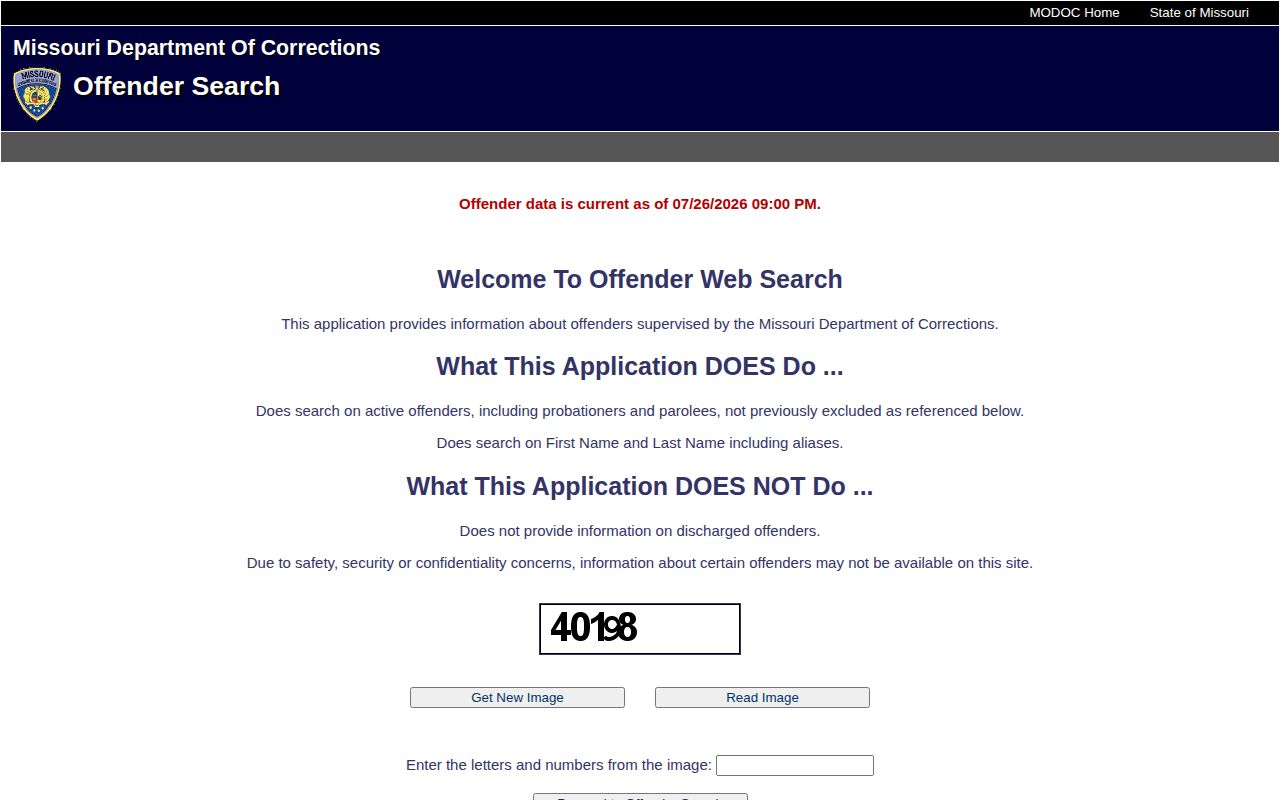
The screen supports an active custody or supervision check, but its exclusion of discharged offenders makes it unsuitable as a complete historical release-date lookup.
If the Marion County Jail roster drops a person after a prison commitment, a transport and intake gap may occur before a MODOC record appears. That gap is not proof of return to the community. Verify the commitment in Case.net, allow for intake, and ask the current custodian when timing is critical.
Missouri Conditional Release Calculations
RSMo § 558.011 divides covered felony terms into prison and conditional-release components. For a term of nine years or less, the conditional-release portion is generally one-third. It is generally three years for a term between nine and fifteen years, and five years for a term over fifteen years, subject to statutory exceptions. The prison term is the remainder.
These fractions explain why a calculated date may precede the maximum, but they are not a do-it-yourself Marion County release calculator. The Parole Board can extend conditional release toward the maximum through the statutory process. Offense date, consecutive or concurrent sentences, court amendments, treatment laws, detainers, and corrections also affect the operative computation.
Conditional release is supervised. A person can be physically outside prison while still under MODOC authority. The release date and the final supervision discharge date may therefore be years apart. The Post-Release Supervision record path explains how active parole, conditional release, and probation status are verified.
Marion Release Minimums and Credit
Under RSMo § 558.019, a person convicted of a dangerous felony as defined by statute and committed to MODOC must serve a minimum prison term of 85 percent of the imposed sentence, or reach age seventy after serving at least forty percent, whichever occurs first under the current text. The minimum prison term is the time before eligibility for parole, conditional release, or another early release. It does not guarantee release at exactly 85 percent.
RSMo § 558.031 addresses credit for qualifying time spent in custody connected with the offense. A Case.net judgment may state jail credit, but MODOC performs the operative computation for a state term. For a local Marion County Jail sentence, the sheriff and sentencing court should confirm how the term, credit, and order produced the actual date.
Eligibility also depends on the actual conviction and governing sentence. A booking charge or charge description is not a conviction and should not be used to infer an 85-percent minimum. Some sentences are not parole eligible. Others are governed by offense-date rules and exclusions that require the current judgment and agency calculation.
Missouri Good-Time Release Dates
RSMo § 558.041 authorizes, but does not guarantee, additional credit against confinement on the institution superintendent’s recommendation and subject to exceptions. Department rules may recognize orderly conduct and rehabilitative program use. Misconduct can result in loss of some or all credit.
The Parole Board’s Blue Book describes administrative parole and good-time consideration as a Board process. Factors can include the offense, conduct, victim information, history, institutional adjustment, program participation, and release plan. Non-paroleable sentences and some cases with conditional release extended to maximum can be excluded. A date calculated with possible credit remains conditional rather than promised.
Earned Compliance Credits under § 217.703 are different. ECC can move the supervision discharge date for an eligible, compliant person in the community. It does not shorten the original prison confinement. Mixing prison good time and supervision compliance credit produces an incorrect release calculation.
No Marion County-specific jail good-time policy or weekend-release rule was found. Do not import MODOC rules into a local jail sentence or promise early Friday processing for a date that falls on a weekend or holiday. Ask the jail and court for the actual local calculation.
Why Marion Release Dates Change
A date can move because the legal record, agency computation, conduct, or release conditions change. The reason should be verified in the judgment, MODOC record, Board material, or custodian response rather than inferred from a new web value.
| Change | Possible effect |
|---|---|
| Corrected judgment | Changes the sentence terms or the facts used in computation. |
| Concurrent or consecutive sentence | Changes how multiple terms overlap or follow each other. |
| Jail credit correction | Adds, removes, or adjusts qualifying prior custody credit. |
| Board action | Sets, delays, reconsiders, or extends a parole-related date. |
| Release-plan problem | Can prevent departure on a tentative date. |
| Institutional misconduct | Can affect good time or Board consideration. |
| Treatment or program need | Can affect eligibility or pre-release action. |
| Detainer or warrant | Can keep the person in custody or transfer custody elsewhere. |
| Calculation correction | Replaces an earlier value when agency data or law is applied differently. |
A favorable parole hearing is not an actual release. The Board can order another hearing in one to five years or set a future date, and later pre-release action still matters. A failed release plan, later warrant, or receiving-agency hold can prevent a person from entering the community on the expected date.
Discharged Marion Records Disappear
Missouri’s public DOC search has a counterintuitive boundary: it includes active parolees and probationers but expressly excludes discharged offenders. A person can remain findable after physical prison release while supervision is active, then disappear after final discharge. A no-result is therefore not proof of a release date, a clean record, or the absence of prior MODOC supervision.
The MODOC Sunshine page identifies data fields and custodian routes for historical confirmation.
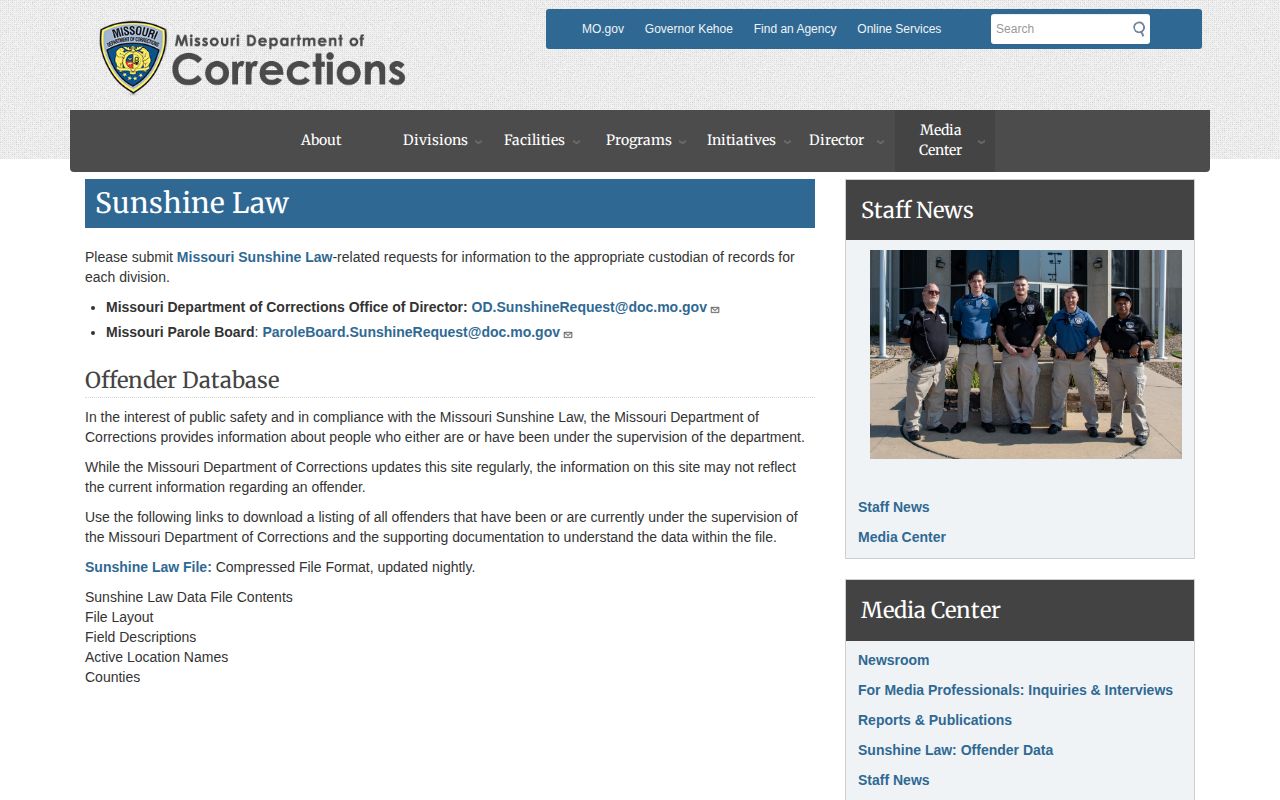
A focused request can seek release and discharge dates, release type, sentence minimum and maximum dates, the completed flag, cause number, and supervision end date.
MODOC also publishes the nightly FAK930 data file covering people who have been or are under its supervision, with some historical data. It contains one row per charge, so a person can appear more than once. The completed flag supports sentence completion but does not prove the physical jail-door time. Match the lifelong DOC identifier and cause number to Case.net, then request the agency record for confirmation.
Confirm Marion Actual Release Dates
For a county-jail event, request the booking sheet, admission date and time, release or transfer date and time, release authority, destination or receiving agency if recorded, and bond or release paperwork from the Marion County Sheriff’s Office. The jail record establishes when local custody ended. The court docket supplies the legal order but may not establish the minute processing finished.
Missouri Sunshine Law generally requires access as soon as possible and no later than the end of the third business day after receipt, or a detailed explanation of the delay and the earliest available production time. Reasonable search, research, and duplication charges may apply under § 610.026. Request electronic copies, an itemized estimate before costs are incurred, and the reasonably separable open portions when a field is withheld.
For a state sentence, compare the active record, court judgment, institutional caseworker or field officer information, Board action, and MODOC record response. If an active record shows a minimum date and a later maximum date, neither proves release on the minimum. If it shows parole, physical prison release occurred while state supervision continued.
Register through VINE Inmate Check for an applicable MOVANS notice by SMS or email, then verify the alert with the source agency. MOVANS can report a status change but does not certify the release reason. Keep minimum, maximum, presumptive, conditional, actual, and discharge dates separate through the entire lookup.