
Marion Parole and Probation
Parole and probation both allow a person to live outside prison, but they begin in different ways. Parole is a release from a prison sentence authorized by the Missouri Parole Board. Conditional release is a supervised part of many felony sentences under Missouri law. Probation is ordered by a court, often instead of prison or after a short jail term. The Missouri Department of Corrections Division of Probation and Parole supervises active cases in all three categories.
A person can be released from physical custody yet remain under MODOC jurisdiction. That is why the words on the active record matter. “Parole,” “conditional release,” and “probation” do not mean final discharge. A Marion County Jail release record answers when the jail gave up custody. The state supervision record answers whether correctional authority continued afterward. The court docket can supply the judgment, probation order, revocation, or commitment that explains the legal route.
| Status | How it begins | Best verification |
|---|---|---|
| Parole | Board-authorized release from prison before the sentence ends | Active MODOC record, field officer, and Board documents |
| Conditional release | Supervised portion of a covered Missouri sentence | MODOC status and sentence records |
| Probation | Court-ordered community supervision | Case.net judgment or order plus active MODOC record |
| Discharge | Agency authority over the sentence or supervision has ended | MODOC record request and court record |
- Absconder
- A person alleged to have stopped reporting or whose location is unknown under the agency process. It does not mean supervision ended.
- Detainer
- A request or authority that can hold a person for another case or agency.
- Revocation
- An official action that cancels community supervision and may return the person to custody.
Verify Marion Post-Release Supervision
The MODOC Offender Search is the starting point for an active Missouri state supervision check. It is protected by a CAPTCHA and includes active inmates, probationers, and parolees. The agency expressly excludes discharged offenders. A no-result therefore cannot prove that the person was never supervised or that a sentence ended on a particular date.
- Complete the visual or audio CAPTCHA and search the exact first and last name. Use the lifelong DOC number when known.
- Compare aliases, descriptors, DOC number, and case context before choosing a record. Do not rely on a same-name match.
- Read the current status and assigned place carefully. Distinguish incarceration from probation, parole, or conditional release.
- Check Case.net for the Marion County judgment, probation order, revocation, sentence, or later docket event.
- Use the official Probation and Parole directory to locate an office, then confirm the assigned officer or reporting site.
- If the interactive search has no result, request the historical supervision and discharge record from the custodian listed on the MODOC Sunshine page.
Hannibal Post-Release Supervision Center
Hannibal contains MODOC’s District 3 Community Supervision Center. It is a post-release supervision and reentry setting, not the Marion County Jail and not a booking archive. MODOC describes community supervision centers as structured facilities for people under state supervision, including people recently released from prison and people at risk of a return to prison.
District 3 serves Marion County plus Schuyler, Scotland, Clark, Adair, Knox, Lewis, Macon, Shelby, Monroe, and Ralls Counties. A person placed at the center has left prison custody but has not necessarily reached final discharge. The District 3 profile supplies the service area and local role. Custody, supervision, and unrestricted community status must not be treated as the same event.
The official address listing provides a visual check of the Hannibal office entry.
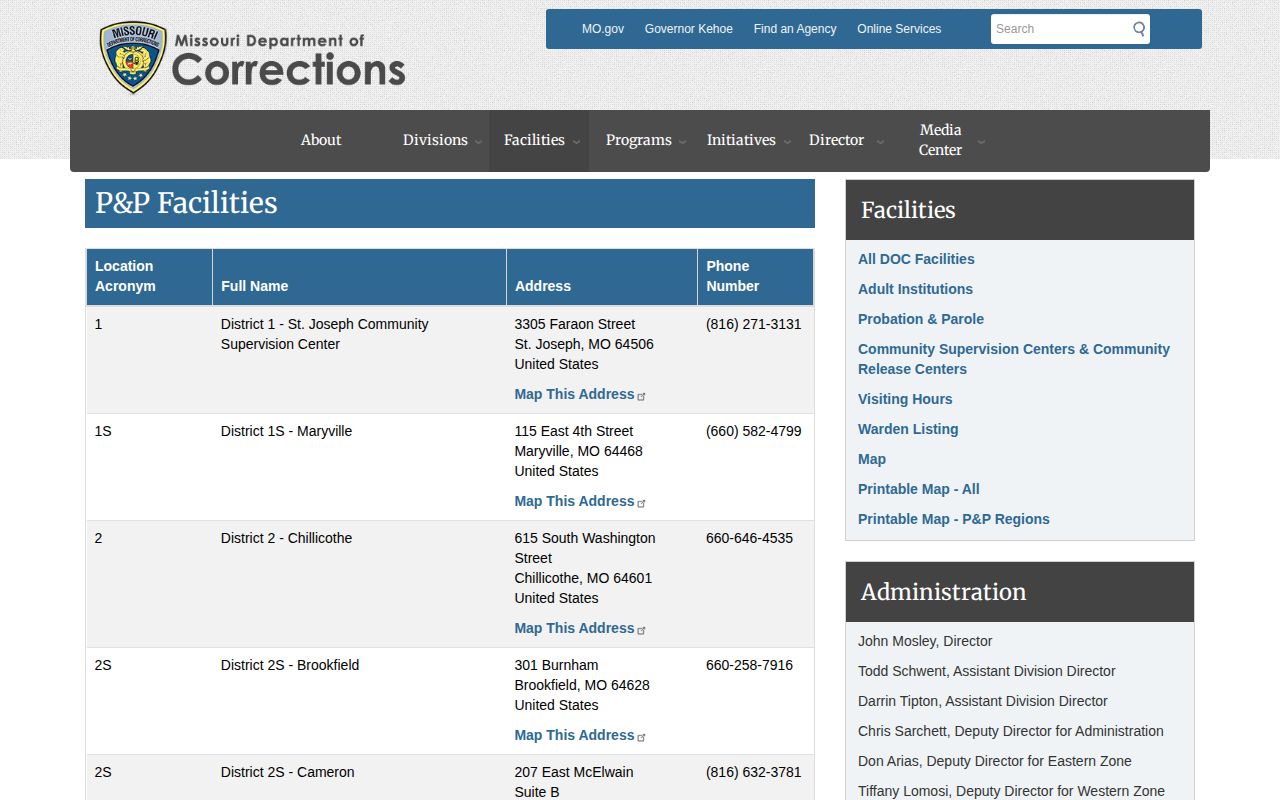
The directory establishes the office and contact route, but it does not identify any person’s assigned reporting location.
Marion Supervision Office Assignment
District coverage is not individual assignment proof. A Marion County address or case does not establish that a person must report at the Hannibal counter. Reporting can depend on the active case, current residence, placement, and agency direction. Confirm the assigned officer through the active MODOC record or an authorized agency channel before traveling or sending case material.
District 3 Community Supervision Center
2002 Warren Barrett Drive
Hannibal, MO 63401
(573) 248-2450
Public staff may limit private case details. Ask how to reach the assigned field officer or use MODOC Constituent Services for a record-level routing question. The office directory confirms where District 3 operates; it does not certify a supervision condition, violation, or discharge.
For parole-hearing notifications and other defined services, the MODOC Office of Victim Services lists 573-526-6516 and victims@doc.mo.gov, Monday through Friday from 8:00 a.m. to 5:00 p.m. That office serves notification functions. It should not be used as a substitute for the field officer’s current supervision record.
Marion Supervision Violations and Warrants
Conditions vary by order and case. They can address reporting, residence, travel, treatment, contact, payments, and compliance with law. The signed court order, parole certificate, and agency instructions control. General web descriptions cannot establish what one Marion County person must do.
A custody notice can help identify a later arrest, but it does not explain whether the cause was a new case, a supervision warrant, or an unrelated hold. Missouri’s current MOVANS portal separates local custody, court, and MODOC events. Registration for one source should not be assumed to cover all three. Match the event source and then obtain the warrant, revocation filing, or agency record that states the basis.
A missed report or no-result should never be converted into an absconder claim. No county-published name list of supervision absconders was located. Under RSMo § 217.720, the parole authority can issue a warrant for a person on parole or conditional release. A warrant or violation can result in arrest and return to custody, but only official agency or court documentation confirms that status.
Use the active MODOC record, the assigned field office, and Case.net warrant or revocation entries. MOVANS may provide a custody-change notice when a participating source updates, but it is not a warrant database. Social posts and secondhand statements are not adequate proof of a violation or absconder designation.
Note: A supervision warrant can change custody without ending the underlying parole, conditional-release, or probation case.
Marion Parole Decisions and Release
The Missouri Parole Board makes parole decisions. A hearing does not establish that release occurred. The Board reviews conduct, institutional adjustment, completed and needed programs, offense information, release planning, and other relevant matters. A result can be another hearing in one to five years or a future release date.
No official public month-by-month, name-searchable hearing calendar or decisions database was found. The Board’s Blue Book provides rule-based timing, and the person receives individual notice. The written Statement of Reasons and available result information may be requested from the Board under the applicable process. Eligibility depends on the sentence, offense date, statutory exclusions, minimum terms, prior commitments where relevant, and Board rules. A charge label alone does not prove eligibility.
The official hearing-process page shows why a hearing is not immediate-release proof.
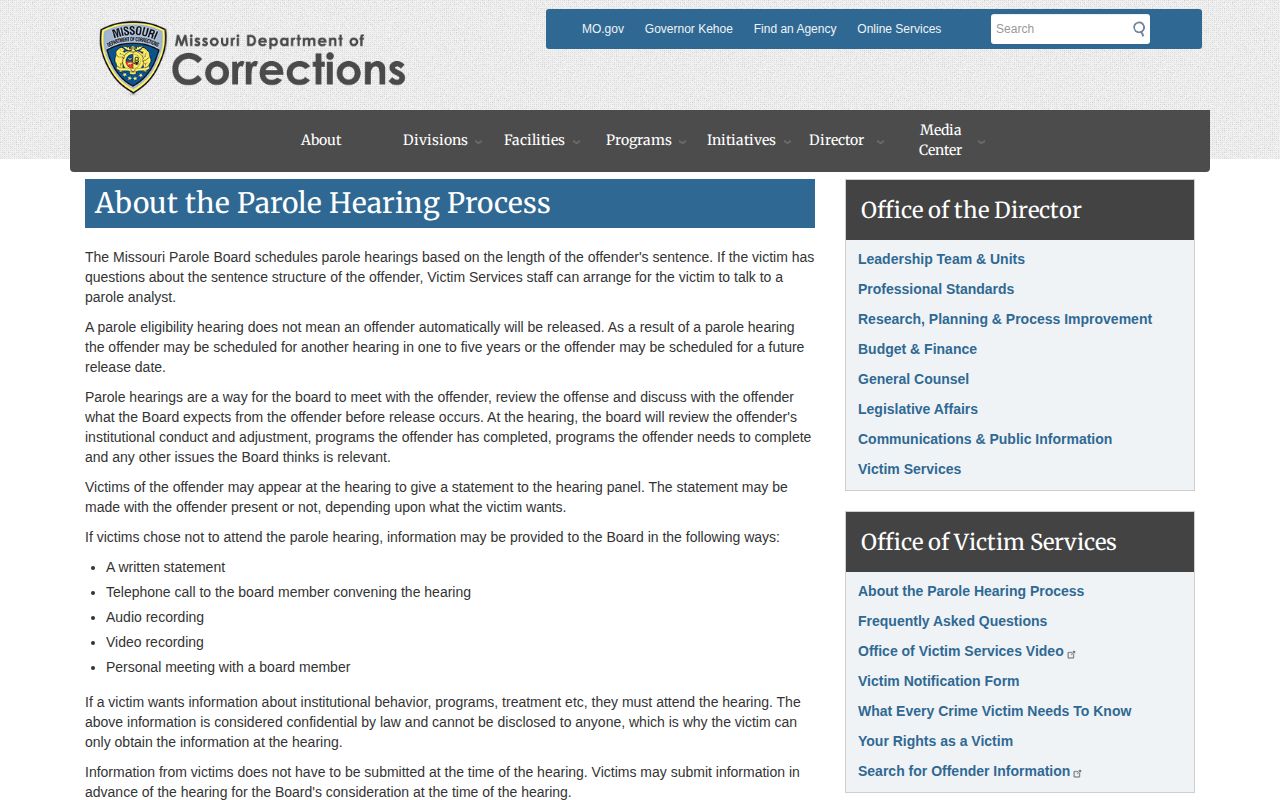
Confirm release through the later MODOC status, release document, and receiving supervision record, not through the hearing event alone.
Marion Supervision Discharge Records
Final discharge ends the relevant MODOC supervision authority. It is different from physical prison release and different from a favorable hearing. While a person remains on active parole, conditional release, or probation, the public offender search may continue to return a record. Once discharged, that same person can disappear because the public tool excludes discharged offenders.
Earned Compliance Credits can affect some community-supervision discharge calculations. Under § 217.703, an eligible and compliant supervisee may receive thirty days of credit for a compliant month, while remaining under DOC jurisdiction for at least twenty-four months before final discharge. Eligibility depends on the offense, date, and MODOC determination. These credits operate during community supervision. They do not shorten the original prison term and should not be described as prison good time.
For historical proof, match the DOC number and Marion County cause number. Request the discharge date, discharge type, end of supervision, completed flag, and related sentence dates through the MODOC Sunshine custodian. The nightly FAK930 data can support research because it contains people who have been or are under MODOC supervision, but one person may have several rows and conversions or incomplete values require care. A completed flag supports sentence completion; it is not a jail-door timestamp.
A narrow request is easier to reconcile than a general question. Ask for the active or completed supervision category, start date, discharge date, discharge type, assigned district if releasable, cause number, completed flag, and any responsive Board record. Ask the custodian to cite the legal basis for a redaction and to produce the open portions. Then compare the response with the court caption so two people with similar names are not combined.
Case.net can preserve the judgment, probation order, revocation, satisfaction, or closure context. The county booking/release record remains the better source for the moment Marion County Jail relinquished custody. The broader Marion County released-inmate search and records path explains how those records fit together.